
If you own a wooded property in Michigan, Northern Indiana, or Northern Ohio, you may eventually find yourself asking what your standing timber is worth and who you should sell it to.
That’s where the difference between a timber buyer and a timber broker matters. Some companies help arrange timber sales between landowners and sawmills. Others purchase standing timber themselves and then sell the harvested logs to another company.
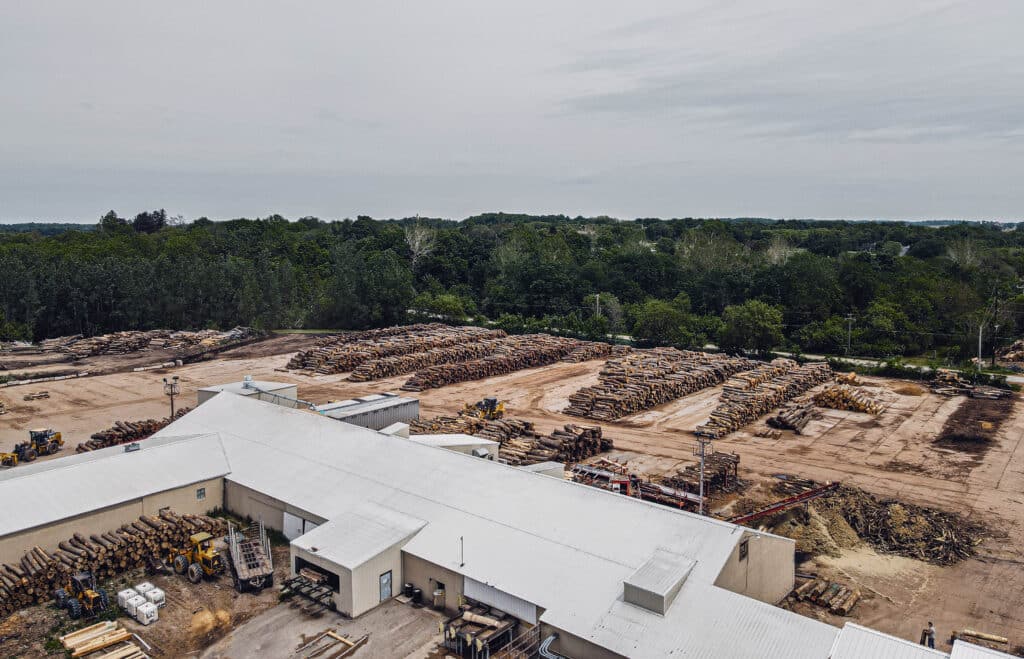
Buskirk Lumber operates differently. We are a sawmill and a direct buyer of standing hardwood timber. When you sell your timber to Buskirk, you’re working directly with the company that purchases the trees, manages the harvest, transports the logs, and processes the timber through our milling operation.
We’ve been in the timber industry since 1920, and our team has the equipment, the harvesting crews, the transportation, and the resources needed to manage the entire process in-house.
Keep reading to learn more about what that means for you as a landowner.
What is a Timber Buyer?
A timber buyer purchases your hardwood trees while they’re still standing. The buyer evaluates the woodlot and determines what the timber is worth based on:
- Tree species
- Tree diameter and size
- Log quality and grade
- Defects or damage
- Accessibility of your property
- Harvesting and transportation costs
- Current market demand
Buskirk Lumber is both the timber buyer and the sawmill. Our operation includes the resources needed to harvest and process that timber after the sale, including logging crews, trucking, sawmills, dry kilns, and other wood-processing operations.
First time selling timber? Read our tips before your first sale.

What is a Timber Broker?
A timber broker acts as an intermediary in the timber market. Rather than being the mill that ultimately processes the logs, a broker may work with landowners to connect them with potential buyers, arrange timber sales, or negotiate transactions.
For a landowner, that can mean the company helping arrange the sale isn’t necessarily the same company purchasing or processing the timber. The timber may pass through another buyer before it reaches a sawmill, adding another party to the transaction.
What Does It Mean to “Sell Mill-Direct” Rather Than to a Broker?
With Buskirk Lumber, there isn’t that disconnect. We buy the standing timber and operate the sawmill that processes it. When you sell your standing timber directly to the sawmill (mill-direct), you’re dealing with the company that purchases the timber and operates the mill that processes the logs. Instead of selling timber to an intermediary that then finds a market for the logs, the timber is purchased for the sawmill’s own operation.
That direct relationship gives the buyer firsthand knowledge of what its mill can use, what types of logs it needs, and how the timber will ultimately be processed.
For you as the landowner, it makes one important question easier to answer: Who is actually buying my trees? Even more importantly, it helps you know that the value of your timber is going directly to you, rather than being purchased by another party and resold to a sawmill for their own profit.

Where Does My Timber Go After I Sell It?
This is something many landowners don’t think about until after they’ve agreed to a sale. Depending on the buyer (broker, logger, or other third party), the logs may move through several businesses before they become lumber.
With a sawmill/mill-direct buyer like Buskirk Lumber, the process is more direct.
- The timber is purchased: If the timber is a fit for the mill and both parties agree to the terms, the sawmill purchases the standing timber.
- The trees are harvested: The timber is harvested according to the terms of the sale and the conditions of the property.
- The logs are transported to the purchasing sawmill: The logs go to the buyer’s sawmill, rather than being sold to another company to determine their next destination.
- The logs are processed: The logs are sorted and processed into lumber and other wood products.
That’s an important distinction of a mill-direct sale: The company purchasing your standing timber is also the sawmill processing the logs, so it has a direct interest in the quality and value of the wood that comes off your property.
Can Selling Mill Direct Get Me More for my Timber?
Selling directly to the mill can reduce the number of parties involved in the transaction, which may allow more of the timber’s value to stay with you as the landowner.
Compared to working with brokers, consulting foresters, and loggers:
Brokers (Middle Men)
- Don’t cut your timber themselves
- Resell cutting rights to third-party sawmills
- Make money by reselling your timber to other sawmills for more money
Consulting Foresters
- Work with landowners to sell timber to sawmills
- Take a percentage of sale proceeds (an average of 15-20%)
Loggers
- Will cut your timber, but they do not actually use the wood
- Resell your timber in log form to sawmills on a 60/40 split with the landowner
Example: If a 100k bdft job has a value of $100,000, the landowner would get $60,000 and the logger/producer would get $40,000. The $40,000 would be the cost of cutting/selling your timber.
Selling Mill Direct
- Allows you to bypass middlemen or brokers
- Allows you to negotiate directly with the sawmill and receive higher prices for your timber
Example: On a 100k bdft job valued at $100,000, a company logging crew would receive between $125 to $150 PT to cut timber, which would equal $15,000. The landowner would receive the remainder of $85,000. That’s $15,000 MORE for their timber just for selling direct to a sawmill!

Why Work With Buskirk Lumber, a Sawmill & Direct Buyer of Standing Timber
Buskirk Lumber has been a part of the hardwood timber industry in Michigan for over 100 years. Our business is structured around the entire timber process: We buy the standing timber, we harvest it, we transport it, we process it, and we put hundreds of end products back into our communities.
That gives us a perspective that companies operating in only one part of the timber supply chain do not have. As a primary or secondary end user of the timber we purchase, we have a direct interest in the quality and value of the wood that comes off your property. We’re also not looking at your woodlot only as a source of trees to remove. Our approach of selective harvesting is based on sustainable forest management for continued growth and productivity.
Learn More About Forest Management with Buskirk Lumber
Thinking About Selling Your Timber?
If you’re considering selling the timber on your property, you don’t need to have the timber market figured out or coordinate multiple companies on your own.
Buskirk Lumber is a direct buyer of standing hardwood timber and an operating sawmill. Our timber procurement team evaluates woodlots throughout Michigan’s Lower Peninsula, Northern Indiana, and Northern Ohio. We handle the entire harvest, transport the logs to our milling operation, and process the timber into hardwood lumber and other products.
With over a century in the timber industry and the resources to manage each aspect of the process in-house, we give landowners a direct path from standing timber to sawmill.
If you’re ready to find out what your timber may be worth, send us a message for a timber assessment or call our timber procurement team at (800) 860-WOOD.